[[2023-03-26-Transformer_LLM]] [[2024-10-11-Linear_Attention]]
Transformer Series

Transformer Layer Block Diagram (1-head)

Math

Multi-Head Attention


Multi-Head Attention 數學表示:
\[\begin{aligned} x_0 & =U W_e+W_p \\ x_l & =\text{transformer\_block}(h_{l-1}) \quad \forall \, l \in [1, n_{layers}] \end{aligned}\]where $U=\left(u_{1}, \ldots, u_{k}\right)$ ($k=1024$) is the context vector of tokens, $n$ is the number of layers, $W_e$ is the token embedding matrix, and $W_p$ is the position embedding matrix.
\[\begin{aligned} \text{MultiHead}(Q, K, V) & =\text{Concat}\left(\text{head}_1, \ldots, \text{head}_{n_{heads}}\right) W_o \\ \text { where \quad head}_i = \text{softmax}(Q_i K_i^T +M)V_i & =\text {Attention}\left(x W_i^Q, x W_i^K, x W_i^V\right) \end{aligned}\]$M$ 是 attention mask, 就是要計算 attention 的部分,會收到兩個 factor 影響
- Token length < context length: 有 token 部分才需要計算,padding 不用,特別是在 pre-fill stage.
- Causal mask: diagonal and lower triangle 才需要計算。主要是在 pre-fill stage 所有 tokens (token length x embed size). 等到 generation stage, 每個進來的 token (1x embed size), 都需要和自己,以及之前的 KV cache 算 attention. M 可以 ignore.
假設 $K, Q, V$ 都有一樣多 heads, $d_{model} = d_{embed} = 768 = head_{num} \times d_{head} \to 768 = 12 \times 64$ \(\begin{aligned} Q =&\left[Q_1, Q_2, ... Q_{12}\right] =& x \left[W^Q_1, W^Q_2, ...W^Q_{12}\right] =& x W^Q \\ K =&\left[K_1, K_2, ... K_{12}\right] =& x \left[W^K_1, W^K_2, ...W^K_{12}\right] =& x W^K \\ V =&\left[V_1, V_2, ... V_{12}\right] =& x \left[W^V_1, W^V_2, ...W^V_{12}\right] =& x W^V \\ \end{aligned}\)
Where the projections are parameter matrices $W_i^{Q,K,V} \in \mathbb{R}^{d_{\text {model }} \times d_{head}} = \mathbb{R}^{768 \times 64}$ and $W^{Q,K,V,O} \in \mathbb{R}^{d_{model} \times d_{model}}= \mathbb{R}^{768\times 768}$.
但是 $x, Q, K, V \in \mathbb{R}^{k \times d_{model}} = \mathbb{R}^{1024 \times 768}$.
接下來的 FF Network:
\(\operatorname{FFN}(x)=\max \left(0, x W_1+b_1\right) W_2+b_2\)
變形 1: MQA, GQA to save Weight+KV Cache Size and BW


變形 2: KV Cache for Interence to Save Memory BW

Embedding - 參數 $W_{e}$ : $n_{vocab} \times d_{model}$,$W_{p}$ : $n_{ctx} \times d_{model}$
-
$U$ 的大小是 ($n_{ctx} \times n_{vocab}$),$W_{e}$ 的大小是 ($n_{vocab} \times d_{model}$),$W_{p}$ 的大小是 ($n_{ctx} \times d_{model}$)。
-
Vocabulary size ($n_{vocab}$) 是 50257。乍看很大,但是 one-hot,也就是 $U$ 的 element 只有 0 或 1. $W_e$ 基本就是一本字典,每一個 vocabulary in 50257 都對應一個 embedding of vector length $d_{model}$.
-
所有的 models 都用同一個 context window, 其大小 $n_{ctx} = 2048$ tokens. 這個 context window size 決定這個 model 的記憶範圍。
-
$h_0$ 的大小是 $(n_{ctx} \times d_{model})$。
Attention Block - 參數 $W_i^{Q,K,V}$ : $3 d_{model} d_{head} n_{head} = 3 (d_{model})^2$,$W^{O} = (d_{model})^2$ , total = $4 (d_{model})^2$, need to add 4 d bias? yes => $4 (d_{model})^2 + 4 d_{model}$
- $Q, K$ 都是 $h_0$, 大小都是 $(n_{ctx} \times d_{model})$
- $V$ 是 output shifted right, 因爲 FFN 保持 input size 到 output size, 所以大小也是 $(n_{ctx} \times d_{model})$
- 對於 MultiHead attention, 每一個 head 的長度是 $d_{head}$,而且 $d_{model} = d_{head} \times n_{heads}$
- 每一個 head 都是三個矩陣乘法,$Q W_i^Q, K W_i^K, V W_i^V$,每個矩陣乘法大小是 $(n_{ctx} \times d_{model})\times (d_{model}\times d_{head})$,所以 head output 大小是 $n_{ctx}\times d_{head}$。但是因爲有 $n_{head}$ 而且 concat 在一起再做一次矩陣乘法 with $W^O$,所以 $\text{MultiHead}(Q,K,V)$ 的大小是 ($n_{ctx}\times d_{model}$).
Feed-Forward Network (FFN) - 參數 $W_{1,2}: 2\times d_{model} \times 4 d_{model} = 8 (d_{model})^2$ and $b_{1,2} = 5 d_{model}$ => $8 (d_{model})^2 + 5 d_{model}$
- Feed-forward network (FFN) 的 input 和 output 都一樣大小 $d_{model}$, 而且只有一層 hidden layer, $d_{ff} = 4 d_{model}$. 這一層 hidden layer 和 input 以及和 output 都是 fully connected network. 所以兩個的參數量都是 $d_{model} \times 4 d_{model}$ 再加上兩個 bias $4 d_{model} + 1 d_{model} = 5 d_{model}$.
- FFN 的最後大小和 input 一樣: ($n_{ctx}\times d_{model}$).
Layer Norm - 參數 $\gamma, \beta$ : $4d_{model}$
elf-attention块和MLP块各有一个layer normalization,包含了2个可训练模型参数:缩放参数 $\gamma$ 和平移参数 $\beta$,形状都是 [ℎ] 。2个layer normalization的参数量为 4ℎ 。
GPT/Llama 總參數量:
一層的 transformer block:
$W_i^{Q,K,V},W_{1,2}, b_{1,2} = 4(d_{model})^2+4 d_{model} + 8(d_{model})^2 + 5 d_{model} + 4d_{model} = 12(d_{model})^2 + 13 d_{model}$
$n_{layers}$ 多層以及加上 $W_e, W_p$ 總參數量:
$n_{vocab}d_{model}+n_{ctx}d_{model}+n_{layers} \times (12 (d_{model})^2+ 13 d_{model})$
Variable 縮寫
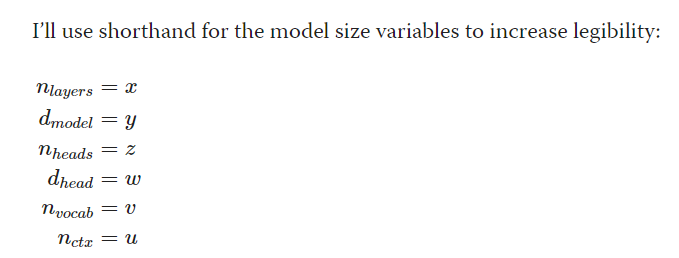
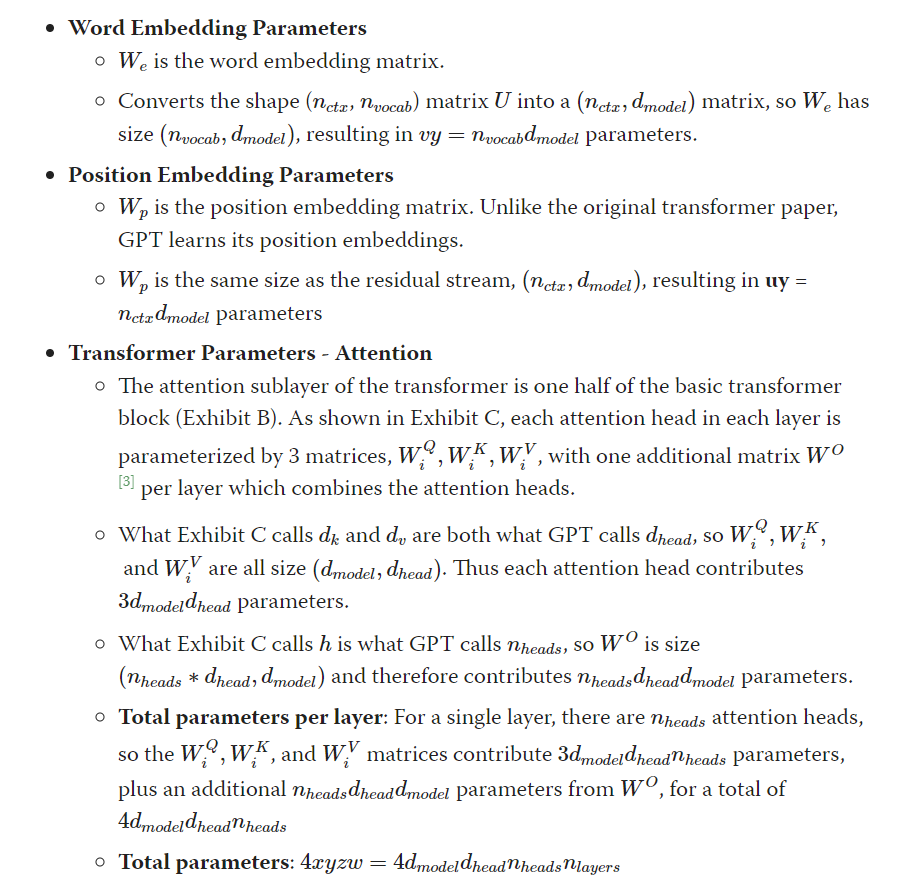
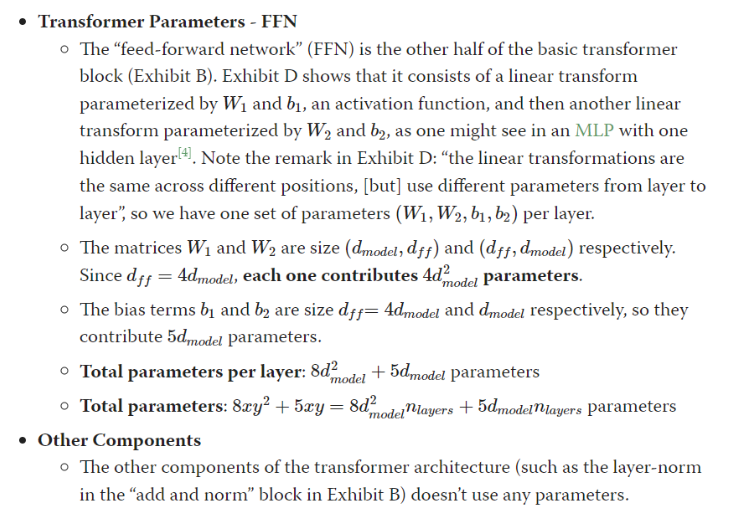
所以總共的參數有:$vy+uy+4xyzw+8xy^2 + 13xy = y(v + u) + x (4yzw+8y^2+13y)$.
一般 $y = zw$ 所以也可以寫成 $y(v+u) + x (12y^2+13y)$.
這也是上式: $P= d_{model} \cdot (n_{vocab}+n_{ctx})+n_{layers} \cdot (12 (d_{model})^2+ 13 d_{model})$
- 注意參數量 (不含 $W_p$) 和 token length 也和 batch 無關。這和 activation 不同!!!
- 如果使用相對位置編碼,例如 RoPE (Llama) or ALiBi, 不包含可訓練的參數,$W_p$ 可以忽略。
- 另一種寫法是 $P = Vh + l (12 h^2 + 13 h)$

Self attention
b = batch 在 training 時,會有 batch input, 在 inference 是 batch = 1 for ChatGPT model.
s = n_ctx (input tokens)
h = d_model ( = num_head * d_head)
- 此處考慮 batch size, 因爲 training.
- ChatGPT inference 的 batch size = 1. 以及在某些 network (大小網絡) batch size > 1 可以加速。
K, Q, V: Mapping Matrix : $Q = x_{in} W_Q,K = x_{in} W_K, V = x_{in} W_V$
- input 和 output shape [b, s, h] x [h, h] –> [b, s, h]
- Input activation 的量是: $p b s h$, p 是 precision, 如果是 FP16, p 是 2 個 byte.
QK: Attention matrix $x_{out} = \text{softmax}\left( \frac{Q K^T}{\sqrt{h}}\right) \cdot V \cdot W_O + x_{in}$
- 此處要考慮 multi-heads, 因此把 3D 的 Q, K, V [b, s, h] reshape 成 4D [b, head_num, s, per_head_hidden_size] where h = d_model = head_num * per_head_hidden_size
- $Q K^T$ 矩陣的 input 和 output [b, head_num, s, per_head_hidden_size] x [b, head_num, per_head_hidden_size, s] –> [b, head_num, s, s]
- Input activation 的量是: $2 p b s h$,
Softmax $x_{out} = \text{softmax}\left( \frac{Q K^T}{\sqrt{h}}\right) \cdot V \cdot W_O + x_{in}$
- input 和 output shape 都是: [b, head_num, s, s]
- Input activation 的量是: $p b s^2 a$,
- 计算完 softmax 函数后,会进行dropout操作。需要保存一个mask矩阵,mask矩阵的形状与 softmax 相同,占用显存大小为 $ b s^2 a$。Make 只需要 1 byte, 不用乘 p.
Score $x_{out} = \text{softmax}\left( \frac{Q K^T}{\sqrt{h}}\right) \cdot V \cdot W_O + x_{in}$
- input 和 output shape 都是: [b, head_num, s, s] x [b, head_num, s, per_head_hidden_size] –> [b, head_num, s, per_head_hidden_size]
- Input activation 的量是: $p b s^2 a + p b s h$,
Output Mapping $x_{out} = \text{softmax}\left( \frac{Q K^T}{\sqrt{h}}\right) \cdot V \cdot W_O + x_{in}$
- input 和 output shape 都是: [b, s, h] x [h, h] –> [b, s, h]
- Input activation 的量是: $p b s h$, 再加上一個 dropout $b sh$, total $(p+1) b s h$
Self-Attention 的 activation
$p b s h + 2 p b s h + p b s^2 a + p b s^2 a + b s^2 a + p b sh + (p+1)bsh = (5p+1) b s h + (2p+1) b s^2 a$
MLP
\[x_{mlp} = f_{gelu} (x_{out} W_1) W_2 + x_{out}\]- 第一個 FC (W1),
- Input activation 的量是: $p b s h$
- GELU 需要保存輸入:$4p b s h$
- 第二個 FC (W2),矩陣乘法的輸入和輸出 [b, s, 4h] x [4h, h] –> [b, s, h]
- Input activation 的量是: $4p b s h$
- 最後有一個 dropout, 需要保存 mask 矩陣, 大小是 $bsh$
MLP 的 activation
$(9p+1) b s h $
另外,self-attention块和MLP块分别对应了一个layer normalization。每个layer norm需要保存其输入,大小为 $pbsh$ 。2个layer norm需要保存的中间激活为 $2pbsh$.
综上,每个transformer层需要保存的中间激活占用显存大小为 $(16p+2) bsh + (2p+1) b s^2 a$ 。对于 $l$ 层transformer模型,还有embedding层、最后的输出层。embedding层不需要中间激活。总的而言,当隐藏维度 ℎ 比较大,层数 $l$ 较深时,这部分的中间激活是很少的,可以忽略。因此,对于 $l$ 层transformer模型,中间激活占用的显存大小可以近似为 $((16p+2)bsh + (2p+1) b s^2 a)*l$ 。
在推断阶段,transformer模型加速推断的一个常用策略就是使用 KV cache。一个典型的大模型生成式推断包含了两个阶段:
- 预填充阶段:输入一个prompt序列,为每个transformer层生成 key cache和value cache(KV cache)。
- 解码阶段:使用并更新KV cache,一个接一个地生成词,当前生成的词依赖于之前已经生成的词。
第 $i$个transformer层的权重矩阵为 $W_Q^i, W_K^i, W_V^i, W_O^i, W_1^i, W_2^i$。
其中 self-attention 的 4 個權重矩陣 $W_Q^i, W_K^i, W_V^i, W_O^i \in R^{h \times h}$。
并且MLP块的2个权重矩阵 $W_1^i \in R^{h \times 4h}, W_2^i \in R^{4h \times h}$。
预填充阶段
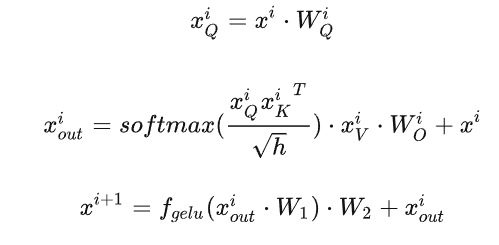
假设第 $i$个transformer层的输入为 $x^i$ ,self-attention块的key、value、query和output表示为 $x_K^i, x_V^i, x_Q^i, x_{out}^i$ 其中 $x_K^i, x_V^i, x_Q^i, x_{out}^i \in R^{b\times s\times h}$。
Key cache 和 value cache 的計算過程為
$x_K^i = x^i \cdot W_K^i$
$x_V^i = x^i \cdot W_V^i$
第 $i$ 個 transformer 層剩餘的計算過程為
解码阶段
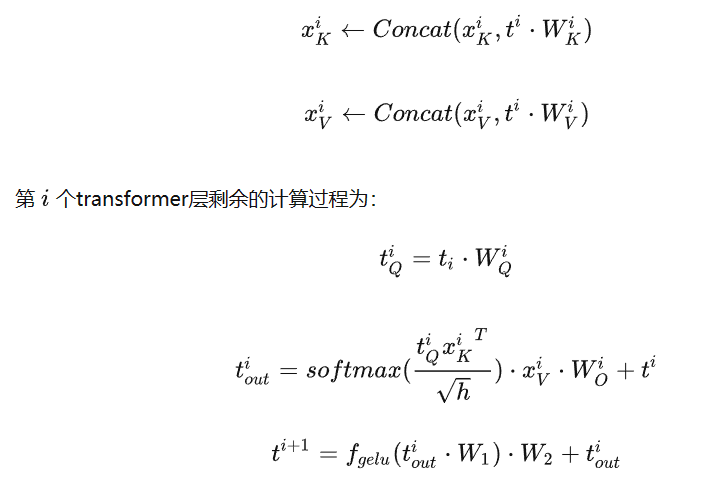
给定当前生成词在第 $i$ 个transformer层的向量表示为 $t^i \in R^{b \times 1 \times h}$. 推理計算分兩部分:更新 KV cache 和計算第 $i$ 個 transformer 層的輸出。
更新 key cache 和 value cache 的計算過程如下:
Attention is what you need, Memory is the Bottleneck
Attention 已經是必備的 core network. 相較於 CNN, attention 最大的問題是 memory bandwidth.
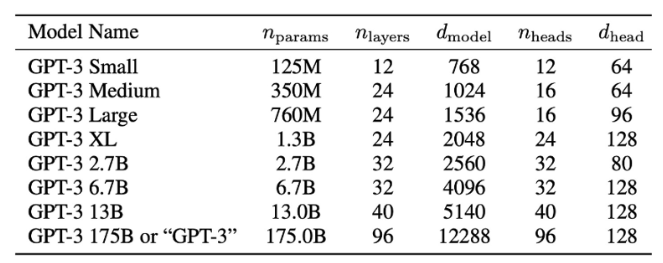
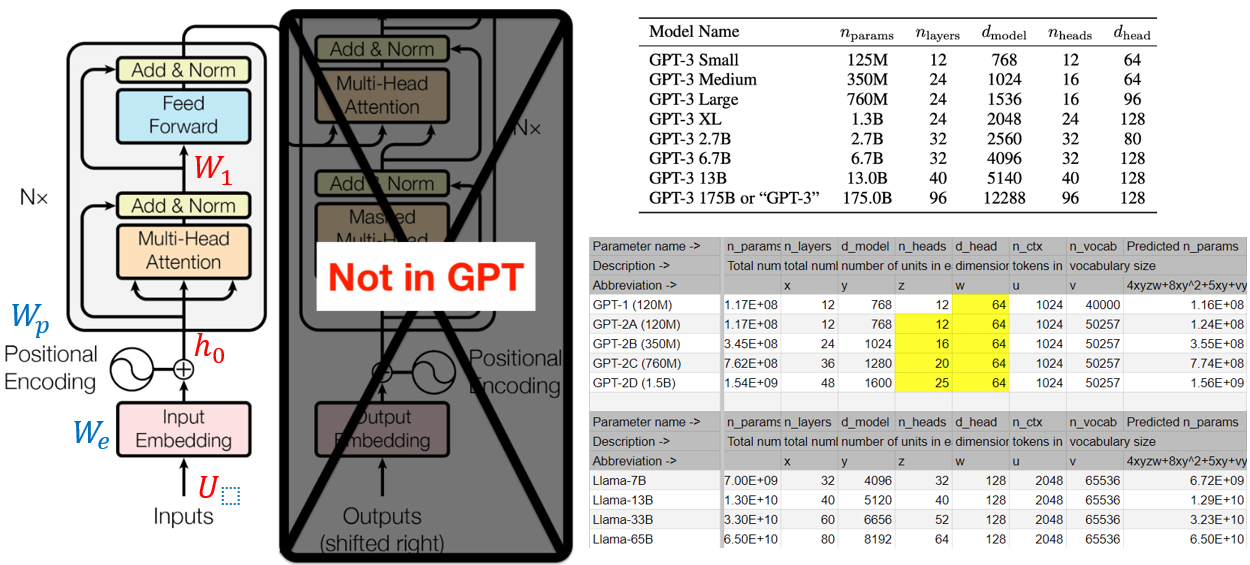
主要在計算 K, Q 的 correlation, 以及 softmax. 以下是 GPT1/2/3 的參數。
下圖應該畫錯了! GPT 應該是 decoder only (右邊)。所以對應的方塊圖是沒有 encoder (左邊),只有 decoder (右邊)。所以打叉的地方相反。BERT 才是 encoder only (左邊)。不過兩者的架構非常類似。不過 decoder only 架構 output 會 shift right 再接回 input, 稱爲 auto-regression.
Source
- Efficient Memory Management for Large Language Model Serving with PagedAttention (arxiv.org)
- Flash Attention with attention bias: https://zhuanlan.zhihu.com/p/567167376
- Flash attention 2: https://tridao.me/publications/flash2/flash2.pdf
- Flash Decoder: https://princeton-nlp.github.io/flash-decoding/
- 詳細的 GPT2/3 參數計算: https://www.lesswrong.com/posts/3duR8CrvcHywrnhLo/how-does-gpt-3-spend-its-175b-parameters
- LLM1, https://finbarr.ca/how-is-llama-cpp-possible/
- FlashAttention图解(如何加速Attention) - 知乎 (zhihu.com)
- NLP(十七):从 FlashAttention 到 PagedAttention, 如何进一步优化 Attention 性能 - 知乎 (zhihu.com)
- 大模型推理性能优化之KV Cache解读 - 知乎 (zhihu.com)
- The KV Cache: Memory Usage in Transformers https://www.youtube.com/watch?v=80bIUggRJf4&ab_channel=EfficientNLP