Good youtube video: https://www.youtube.com/watch?v=Ohrl3S2wcBU&list=PLDcSwjT2BF_WVum1CMO9hMSIa7TyrGjsK&ab_channel=Mathemaniac
Mathemaniac 的 youtube video 是從 Michigan University 的 Gabriele Carcassi 的 paper 和 video 得出的! 他另外有 12 不同的 Hamiltonian 的表示法。
Lagrangian Lagrange multiplier, Legendre transform, Hamiltonian
Some questions:
我們從問題出發
-
The relationship between Lagrangian, Hamiltonian, and Legendre transformation.
-
The relationship between Lagrangian and Lagrange multiplier.
-
The physical interpretation of Lagrangian and Lagrange multiplier.
-
The geometric interpretation of Lagrange multiplier.
-
Add optimization Lagrangian dual problem!
Duality (optimization) - Wikipedia
Usually the term “dual problem” refers to the Lagrangian dual problem but other dual problems are used – for example, the Wolfe dual problem and the Fenchel dual problem. The Lagrangian dual problem is obtained by forming the Lagrangian of a minimization problem by using nonnegative Lagrange multipliers to add the constraints to the objective function, and then solving for the primal variable values that minimize the original objective function. This solution gives the primal variables as functions of the Lagrange multipliers, which are called dual variables, so that the new problem is to maximize the objective function with respect to the dual variables under the derived constraints on the dual variables (including at least the nonnegativity constraints).
Lagrangian 和 Hamiltonian 基本的不同
- Hamiltonian 先天承認 (p, q) 是兩個不同的物理量。 Lagrangian 只有 $q$ 和 $\dot{q}$ . 在牛頓物理 $p = \dot{q}$ 最多差一個 scaling constant. 但在相對論力學,量子力學則並非如此。
- Hamiltonian 和 Lagrangian 是等價的物理框架。基本 $H(p, q)$ 和 $L(p, \dot{p})$ 的轉換就是 Legendre transform: $H(p, q) = p \dot{q} - L(q, \dot{q})$
- Hamiltonian 似乎更有幾何意義 (phase plane) 以及物理 intuition.
- Hamiltonian 是 2N (DoF) 個 first-order 微分方程。Lagrangian 是 N 個 second-order 微分方程。從數值分析角度比較 prefer Hamiltonian.
flowchart LR
    A["構形空間<br/>(Configuration Space)<br/>變數:q, 𝑞̇"]
        -->|動作量最小原理<br/>δS = 0|
    B["Lagrangian 形式<br/>L(q, 𝑞̇, t)"]
        -->|Legendre 變換<br/>p = ∂L/∂𝑞̇|
    C["Hamiltonian 形式<br/>H(q, p, t) = p𝑞̇ − L"]
        -->|相空間動態<br/>辛結構 (Symplectic Geometry)|
    D["相空間<br/>(Phase Space)<br/>變數:q, p"]
        -->|Hamilton 方程|
    E["狀態演化<br/>𝑞̇ = ∂H/∂p<br/>ṗ = −∂H/∂q"]

    style A fill:#eef,stroke:#88f,stroke-width:1.5px
    style B fill:#ddf,stroke:#88f,stroke-width:1.5px
    style C fill:#dff,stroke:#4bf,stroke-width:1.5px
    style D fill:#cfc,stroke:#4b4,stroke-width:1.5px
    style E fill:#ffc,stroke:#aa4,stroke-width:1.5px
flowchart LR
    A["構形空間 (Configuration Space)\n變數: q, q_dot"]
        -->|動作量最小原理: δS = 0|
    B["Lagrangian 形式\nL(q, q_dot, t)"]
        -->|Legendre 變換: p = ∂L/∂q_dot|
    C["Hamiltonian 形式\nH(q, p, t) = p·q_dot − L"]
        -->|相空間動態\n辛結構 (Symplectic Geometry)|
    D["相空間 (Phase Space)\n變數: q, p"]
        -->|Hamilton 方程|
    E["狀態演化\nq_dot = ∂H/∂p,  p_dot = −∂H/∂q"]

    style A fill:#eef,stroke:#88f,stroke-width:1.5px
    style B fill:#ddf,stroke:#88f,stroke-width:1.5px
    style C fill:#dff,stroke:#4bf,stroke-width:1.5px
    style D fill:#cfc,stroke:#4b4,stroke-width:1.5px
    style E fill:#ffc,stroke:#aa4,stroke-width:1.5px
Relation (and physical interpretation) between Lagrangian, Hamiltonian, and Legendre Transformation
、
1, Lagrangian = T - V (KineTic energy - Potential energy)
-
generalized Lagrangian
Hamiltonian: why it equal to least action? but action is the integration of Lagrangian, not Hamiltonian?
-
Why the Lagrangian and Hamiltonian is linked by Legendre transformation?
![[Pasted image 20250516000511.png]]
![[Pasted image 20250516000539.png]]
Relation of Lagrangian and Lagrange multiplier, and the physical interpretation of Lagrange multiplier.
Answer 0: 只是巧合。除非 Lagrange 的研究都是獨立的題目。不然應該不是如此。
Answer 1: Lagrangian 一般是在 non-constraint 下的定義。大多數物理問題都有 constraints, 例如 surface, 剛體的限制。boundary. 這些限制就成為 Lagrangian multiplier 的 constraints. Lagrange 可能看到這些 constraint 應而發展除 Lagrange multiplier. 不過這只是很表面的關聯。
Answer 2: 這些 constraints, physically 可以視為 generalized force!!
Lagrange multiplier Physical interpretation
wiki Lagrange multiplier: generalized force. (Wiki Lagrangian multiplier)!!
Lagrangian coefficients $\lambda_k$ 就是 generalized force!
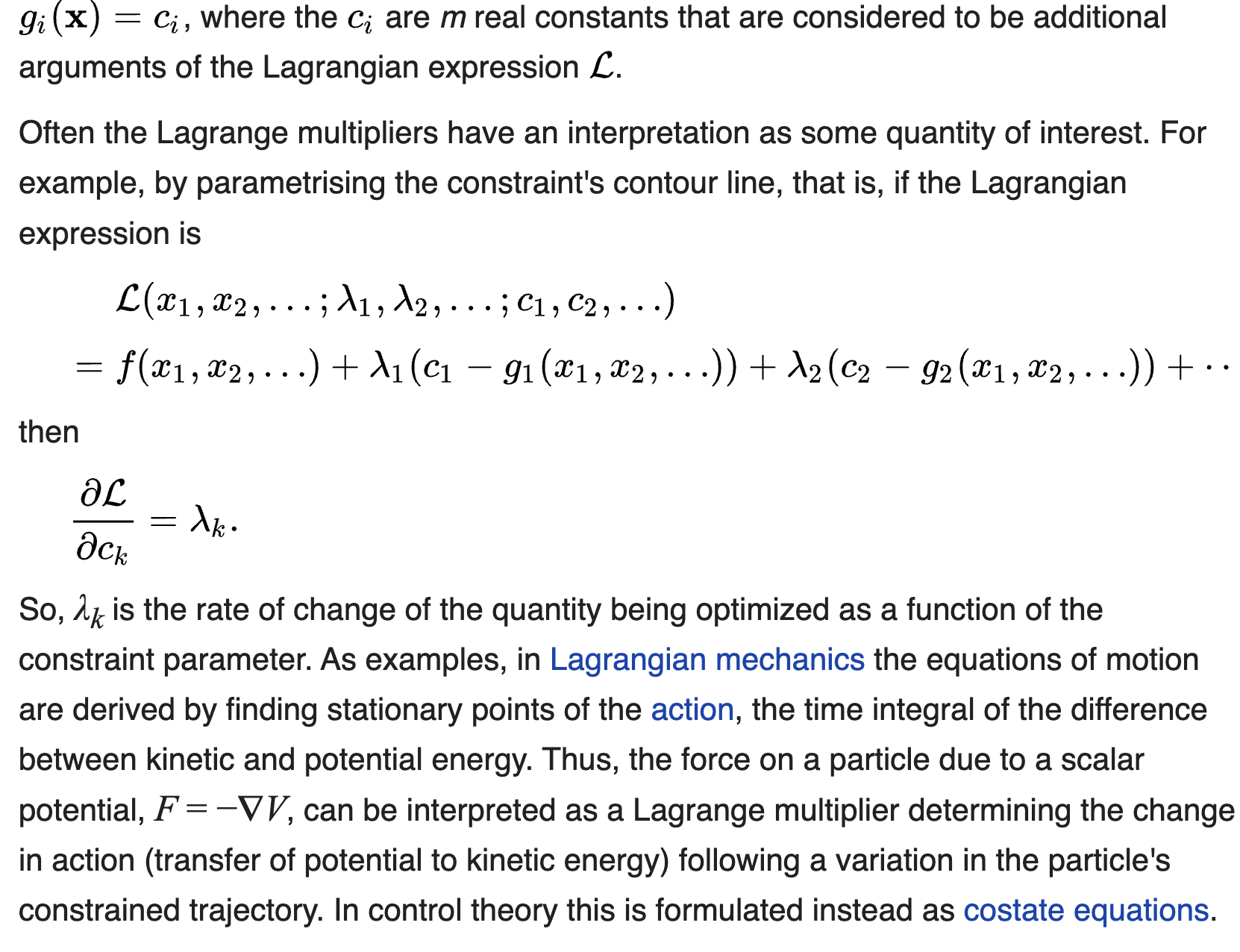
Answer 3: Lagrangian 本身的定義就應該從 (Physically) Lagrange Multiplier 出發!
https://physics.stackexchange.com/questions/590960/application-of-lagrange-multipliers-in-action-principle
https://physics.stackexchange.com/questions/622727/connection-between-different-kinds-of-lagrangian
In Goldstein’s Classical Mechanics, he suggests the use of Lagrange Multipliers to introduce certain types of non-holonomic and holonomic constraints into our action. The method he suggests is to define a modified Lagrangian𝐿′(𝑞˙,𝑞;𝑡)=𝐿(𝑞˙,𝑞;𝑡)+∑𝑖=1𝑚𝜆𝑖𝑓𝑖(𝑞˙,𝑞;𝑡),
-
It should be stressed that the constraints
𝑓ℓ(𝑞,𝑞˙,𝑡),ℓ ∈ {1,…,𝑚}fℓ(q,q˙,t),ℓ ∈ {1,…,m}
depends implicitly (and possible explicitly) of time
其實 1/2/3 都很類似。只是說法不同。
Answer 4: Lagrangian 本身的定義就應該從 (Based on optimization theory) Lagrange Multiplier 出發!
這是從更廣泛的 optimization 出發。 Physical Lagrangian mechanics 只是大自然的 optimization theory.
General optimization 一定會有 constrains, Lagrange multiplier 是 optimization theory 的基本。另外有 Lagrangian dual problem (primal and dual optimization). 參見 convex optimization from Steven Boyd.
Usually the term “dual problem” refers to the Lagrangian dual problem but other dual problems are used – for example, the Wolfe dual problem and the Fenchel dual problem. The Lagrangian dual problem is obtained by forming the Lagrangian of a minimization problem by using nonnegative Lagrange multipliers to add the constraints to the objective function, and then solving for the primal variable values that minimize the original objective function. This solution gives the primal variables as functions of the Lagrange multipliers, which are called dual variables, so that the new problem is to maximize the objective function with respect to the dual variables under the derived constraints on the dual variables (including at least the nonnegativity constraints).